 Orisod
What a watermark can accomplish
A watermark is a visible label, not a security control. Depending on its position, it can make cropping or editing less convenient and can preserve a name, handle, or website when the image is shared unchanged. It may also cover part of the subject, so its value depends on how the image will be used.
Choose how prominent the watermark should be
A large central mark is harder to remove without affecting the picture, but it can obscure the work you want people to evaluate. A small translucent mark preserves more of the photograph and is easier to crop away. Select a size, opacity, and position that fit the purpose: client preview, public portfolio, social post, or final delivery.
Where to place it
- Corner placement: the most common choice; it stays out of the main subject while remaining clearly visible.
- Diagonal across the image: much harder to crop out cleanly, common for stock photography previews and situations where deterring theft matters more than aesthetics.
- Near the subject but not on it: a middle ground that keeps the watermark associated with the image's focal point without directly covering important detail.
If discouraging reuse is the priority, placing the mark tight against an edge makes it easy to remove with a small crop. Moving it inward improves resistance, although no position makes it permanent.
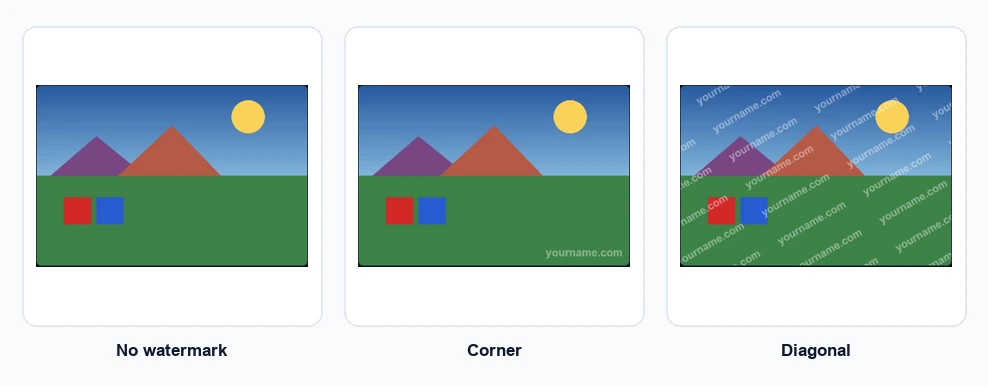
Decide what the mark should identify
Text can name the creator or provide a website that remains understandable outside its original context. A logo supports visual consistency but may be unclear to someone who does not recognize it. Combining a compact logo with a readable name or handle can provide both, as long as the result does not overpower the image.
Balance deterrence with presentation
The core tension with any watermark is that the more effective it is at deterring theft, the more it typically interferes with the photo itself. There's no setting that's correct for every use case. A client preview you want reused sparingly calls for a bolder mark than a final delivered image, and a portfolio piece meant to showcase quality work benefits from something unobtrusive that doesn't distract from the photography itself.
Preview the mark before exporting
Enter the watermark text, adjust its position and opacity, and inspect the preview at the image's intended display size. Check both light and dark areas: a mark that is readable over one part of the photograph may disappear over another.
Watermarking previews vs final delivered work
Many photographers and designers watermark work differently depending on its stage. A preview shared with a client before payment or approval often gets a bolder, harder-to-remove watermark, since the goal is specifically to prevent use before the transaction completes. The final delivered file, once payment has cleared, might carry no watermark at all, or a subtle credit line. The protection need is different once the image has changed hands.
Questions before watermarking a photo
Can a watermark be removed? With enough effort, yes. No watermark is truly unremovable. Its real value is making casual, low-effort reuse much less appealing, not creating an unbreakable barrier.
Should I watermark every photo I post online? It depends on your goals: if credit and reuse matter to you (professional or commercial work), watermarking consistently helps; for casual personal photos, it's often unnecessary.
Does a watermark affect image quality? The exported image contains new pixels where the mark is applied and may also be re-encoded. Keep the unmarked original separately; adding a watermark to a copy does not alter that source file.
Watermark your photos now
Orisod's watermark tool lets you add custom text, choose the position and opacity, and export instantly. All processed locally in your browser.
Add a watermark →Use a watermark as attribution or a modest deterrent, not as proof of ownership or a barrier against copying. Keep the original file and other authorship records when provenance matters.